
How to Identify Authentic Arabic Ghee: Sensory Benchmarks for Pure Dairy Butterfat
Authentic Syrian baladi ghee is defined by the meticulous isolation of pure milk fat from moisture and dairy whey solids. Due to its culinary value and documented wellness properties, commercial adulteration with hydrogenated fats and synthetic flavors remains a market challenge. The following five empirical benchmarks provide definitive verification of pure butterfat without specialized laboratory hardware.
1. Palm Melting Point Benchmark (32–36°C)
Pure animal milk fat possesses a distinct melting range between 32°C and 36°C, which sits naturally below human body temperature (37°C). Conversely, hydrogenated vegetable oils and commercial shortenings are formulated with higher melting thresholds exceeding 40°C.
Direct Palm Liquefaction Procedure
Positive Indicator: Pure ghee transitions immediately into a smooth, clear liquid that absorbs cleanly into the skin without tackiness or waxy residue. Inflexible solidity or a sticky film confirms the presence of hydrogenated fats.
2. Natural Granular Crystalline Texture (Al-Tarmal)
Fine crystallization (traditionally termed Al-Tarmal) is the hallmark physical property of genuine Awassi sheep ghee and pasture cow ghee. This structure develops as triglycerides slowly crystallize during gradual post-clarification cooling.
Palate Melt & Consistency
Positive Indicator: The sample displays micro-fine granular crystals that dissolve instantly into a velvety liquid upon contact with oral warmth. Artificially smooth ointment-like textures or stiff lumps indicate industrial adulterants.
3. Pastoral Herbal Bouquet & Aromatic Profile
Herds grazing in Deir ez-Zor, the Eastern Region, and the Syrian Badia consume wild artemisia (Shih) and steppe herbs, imparting subtle, complex aromatic notes to the butterfat.
Authentic baladi ghee releases a gentle, appetizing dairy bouquet that expands progressively under mild heat. Artificially flavored products emit an immediate, harsh chemical butter odor upon opening, used commercially to mask deodorized seed oils.
4. Thermal Stability & High Smoke Point (>250°C)
Proper artisanal clarification achieves zero residual moisture and complete removal of milk solids, elevating the thermal smoke point beyond 250°C (482°F), making it exceptionally stable for gourmet cooking and pastries.
Direct Pan Heating Behavior
Positive Indicator: The ghee liquefies cleanly into an amber sheen without water spattering, dense foam, or acrid black smoke. Violent bubbling denotes moisture contamination; burnt dregs point to unclarified tallows.
5. Structural Consistency Under Refrigeration
When cooled in a domestic refrigerator for four hours, pure dairy fat solidifies into a single homogeneous block with uniform density and color throughout.
Separation into distinct layers (a solid sediment topped by liquid oil or visible color stratification) conclusively proves the addition of lower-density vegetable oils with divergent crystallization profiles.
6. Authentic vs Commercial Matrix Comparison
| Physical Benchmark | 100% Authentic Arabic Ghee | Adulterated & Hydrogenated Fats |
|---|---|---|
| Melting Point | Liquefies at body temperature (32–36°C) | Requires >40°C; leaves waxy residue |
| Texture & Granules | Fine crystalline granules melting smoothly on tongue | Overly slick ointment texture or stiff lumps |
| Aromatic Profile | Warm, nuanced herbal and rustic dairy notes | Aggressive synthetic flavorings or completely odorless |
| Heat Behavior | Smoke point >250°C; clear amber melt without spatter | Violent bubbling, dark smoke, and burnt residues |
| Refrigeration | Solidifies uniformly into a single homogeneous mass | Separates into distinct liquid oil and solid fat layers |
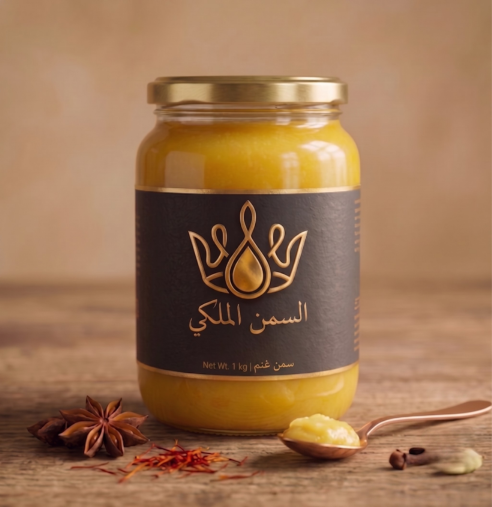
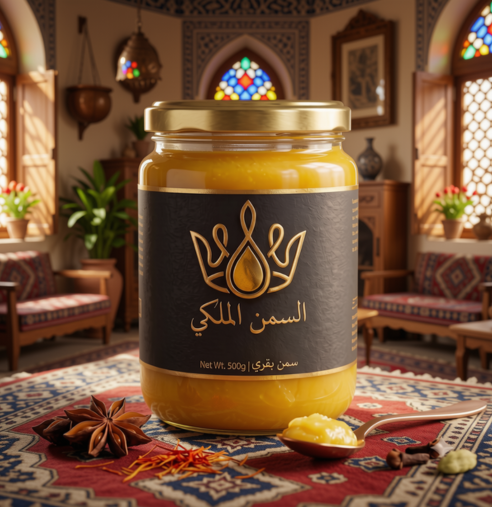
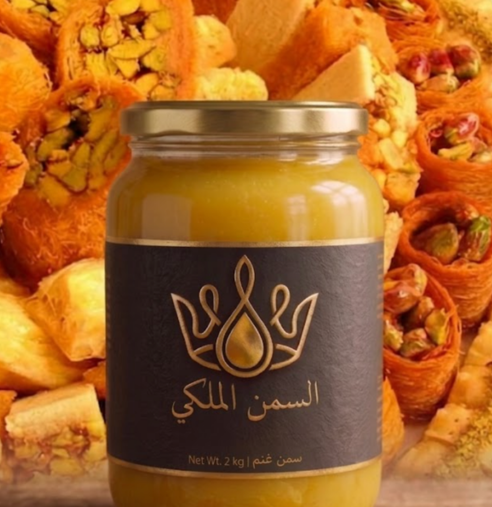
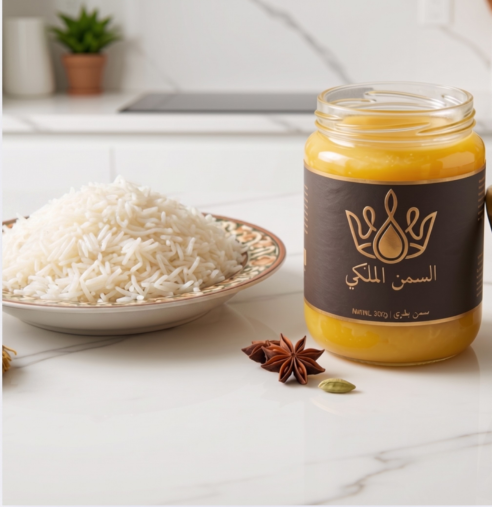
Certified 100% Pure Syrian Ghee Selections
Artisanal batches crafted and tested to rigorous dairy standards
8. Frequently Asked Verification Questions
Does yellow pigmentation indicate artificial colorants?
Not necessarily. Cow ghee naturally features a golden-yellow hue resulting from dietary beta-carotene synthesized from green pasture grazing. Awassi sheep ghee, conversely, is naturally ivory-white. Adulteration is suspected when artificial dyes are used to tint cheap white vegetable fats with bright synthetic yellow.
What are the optimal storage conditions post-opening?
Store in an airtight glass or tin container in a cool, dark pantry away from heat and direct sunlight. Always utilize a completely dry, sanitized utensil to prevent moisture intrusion.
How reliable are sensory checks versus laboratory testing?
Empirical sensory checks identify gross adulteration with high accuracy (>90%), while formal laboratory analysis (peroxide values, fatty acid profiling, moisture assay) confirms full compliance with Syrian and international food purity benchmarks.