
What is the Authentic Color of Pure Arabic Ghee and What Does It Indicate? Sensory Benchmarks, Sheep vs. Cow Butterfat Hues, and Purity Indicators
The visual appearance of clarified milkfat serves as an immediate biological signature revealing animal breed, pasture ecology, and craftsmanship purity. While some consumers mistakenly expect a single uniform color across all butterfat, scientific analysis proves that authentic Arabic ghee spans from pearly ivory cream to radiant golden yellow depending on biological conversion mechanisms and seasonal grazing as explored in our sheep vs cow ghee study and our pure ghee identification guide. This empirical report outlines the exact color benchmarks of genuine Syrian ghee.
1. Pigment Biochemistry: Beta-Carotene vs. Vitamin A
Clarified milkfat coloration is determined by the animal digestive ability to metabolize botanical beta-carotene from fresh green forage:
- Bovine Metabolism (Cows): Cows absorb beta-carotene and transfer it directly into milkfat globules without complete enzymatic cleavage, giving pure cow ghee its warm golden yellow tone.
- Ovine Metabolism (Awassi Sheep & Goats): Sheep possess highly active hepatic enzymes that convert 100% of dietary carotenoids into colorless, bioavailable Vitamin A prior to lactation, resulting in pristine ivory-white ghee.
Neutral White Light Evaluation Protocol
2. Visual Differences: Awassi Sheep vs. Baladi Cow Ghee
Visual inspection offers immediate confirmation of dairy origin:
- Awassi Sheep Ghee: Solidifies into an ivory-white crystalline grain matrix; turns into a crystal-clear, transparent oil when melted at 40°C.
- Baladi Cow Ghee: Solidifies into a warm amber-gold texture; turns into a brilliant golden liquid with mirror-like clarity upon melting.
3. Spring Pasture Flushes & Seasonal Color Intensity
Carotenoid density fluctuates rhythmically with regional pasture conditions across the Syrian steppe:
During peak spring when herds graze on fresh wild legumes and chamomile, natural beta-carotene concentration reaches its zenith. Cow ghee takes on a deep radiant gold, while sheep ghee develops subtle warm undertones with ultra-fine granular crystallization.
4. Detecting Adulterated Dyes: Turmeric & Industrial Yellows
Unscrupulous producers often dye cheap hydrogenated vegetable fats with turmeric or artificial food dyes to simulate expensive cow ghee as detailed in our adulterated ghee investigation:
- Harsh Neon Orange Tone: Synthetic coloring produces an unnatural, flat yellow-orange hue lacking the translucent dairy luminosity of real butterfat.
- Water Separation Test: When a spoonful of dyed fat is melted in warm water, artificial water-soluble dyes disperse into the liquid, whereas genuine butterfat floats on top in a pure, uncolored layer without staining the water.
5. Storage Color Shifts & Photo-Oxidation Warnings
Light exposure and oxidation directly alter milkfat pigment stability:
- Surface Photo-Bleaching: Direct sunlight exposure breaks down carotenoid bonds, causing the surface layer of cow ghee to lose its golden vibrancy.
- Dark Brown Margins: Darkening or localized brown halos indicate lipid peroxidation caused by moisture contamination or excessive storage temperatures.
6. Official Color Matrix for Syrian Heritage Ghee
| Ghee Classification | Solid State Hue (20°C) | Liquid State Hue (40°C) | Craftsmanship Authenticity Standard |
|---|---|---|---|
| Pure Awassi Sheep Ghee | Pearly Ivory Cream (Off-White) | Crystal-Clear Transparent with Silver Sheen | 100% free of cow fat dilution and plant oils |
| Pure Baladi Cow Ghee (Hama) | Luminous Warm Golden Yellow | Radiant Amber Gold | Pasture-fed botanical carotenoid enrichment |
| Royal Hospitality Blend (50/50) | Silky Buttercream Yellow | Light Translucent Gold | Homogeneous blend with zero phase separation |
| Mountain Goat Ghee | Snow White Matte | Aqueous Transparent Liquid | Complete biological conversion to Vitamin A |
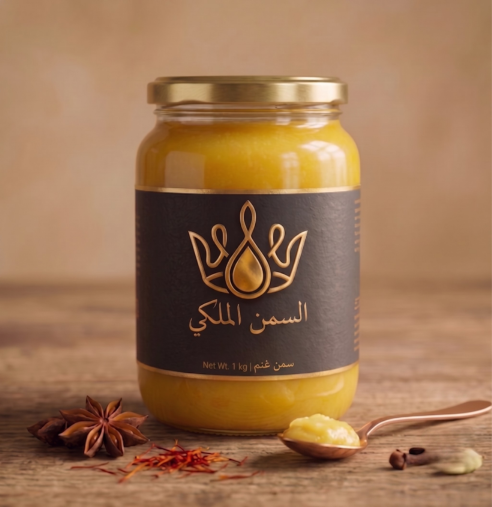
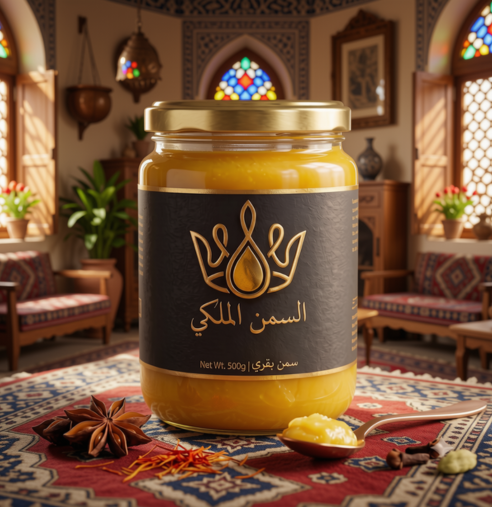
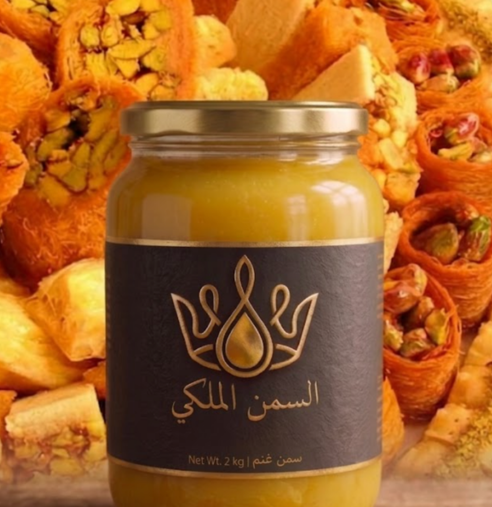
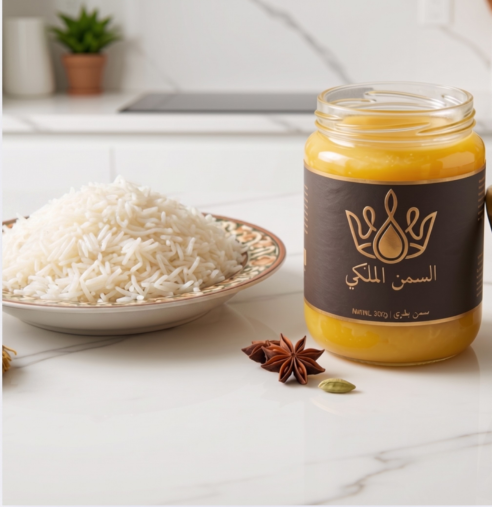
Certified Artisan Heritage Ghee Selection
Pure Syrian clarified butterfat exhibiting natural heritage pigmentation without synthetic dyes
8. Frequently Asked Color & Purity Questions
Does yellow sheep ghee indicate superior quality?
On the contrary: genuine pure Awassi sheep ghee is naturally ivory-white. If sheep ghee displays a pronounced yellow color, it indicates dilution with cow ghee or artificial coloring.
Why does cow ghee color vary between winter and spring?
Seasonal variation reflects diet. During spring grazing on fresh clover, cow milkfat absorbs high beta-carotene levels, producing deeper gold tones compared to winter dry forage feeding.
Does Al Samn Al Malaki guarantee zero added colorings?
All batches undergo spectrophotometric analysis and gas chromatography testing to ensure that all color profiles are 100% natural and free from artificial dyes.