
Why Does Ghee Texture Change? Milkfat Crystallization Physics, Grain Dynamics & Phase Shift Analysis
Understanding why ghee texture changes between clear golden liquid, velvety granular semi-solid (Danedar), and firm waxy solid is a primary point of inquiry among culinary enthusiasts. Far from being a manufacturing defect or sign of spoilage, these dynamic physical shifts are the definitive proof of 100% pure, natural butterfat free from artificial emulsifiers, stabilizers, or hydrogenated plant oils, as demonstrated in our pure ghee identification guide and our ghee color analysis. This empirical report explores the thermodynamic crystallization of pure clarified butterfat.
1. Milkfat Polymorphism: The Three Crystalline Phase States
Pure clarified ghee is composed of diverse triglyceride molecular chains that solidify into three distinct polymorphic crystal forms:
- Alpha Crystals (Rapid Chilling): Unstable, fine crystals that form under rapid sub-zero cooling in refrigerators (4°C), producing a smooth, uniform waxy solid.
- Beta-Prime Crystals (Slow Cooling): Spherical, highly stable crystal structures that form during slow cooling between 20°C and 24°C, creating the prized Danedar granular texture.
- Beta Crystals (Thermal Fluctuation): Coarser, larger crystals resulting from repeated temperature shifts.
Danedar Granular Crystallization Mechanics
2. The Danedar Grain Secret: How Spherical Crystals Form
Granular texture is a natural fingerprint of unadulterated heritage butterfat:
- Broad Melting Spectrum: Natural milkfat melts gradually between 5°C and 40°C, ensuring that ghee melts instantly upon contact with human body temperature (37°C).
- Absence of Chemical Stabilizers: Counterfeit ghee adulterated with hydrogenated oils cools into an unnatural, flat, greasy block that clings uncomfortably to the palate as documented in our adulterated ghee investigation.
3. The 3 Texture States: Liquid Oil, Granular Semi-Solid & Firm Block
Ghee naturally navigates three physical states depending on ambient climate:
- Liquid State (Above 32°C): Crystal-clear golden oil during warm summer months as explored in our summer storage guide.
- Granular State (18°C – 25°C): Velvety, scoopable semi-solid ideal for gourmet cooking.
- Firm Solid State (Below 15°C): Dense pale ivory block resulting from refrigeration as detailed in our ghee refrigeration analysis.
4. Natural Fat Fractionation: Oil Layering vs. Grain Sediment
In moderate temperatures, a liquid oil layer may rest atop granular sediment at the container base:
This layering is entirely natural and safe. Liquid unsaturated oleic triglycerides naturally rise due to lower density, while denser saturated crystal spheres settle downward. A brief stir with a dry spoon or slow ambient cooling restores full homogeneity.
5. Melting Point Profiles: Awassi Sheep vs. Baladi Cow Ghee
Lipid composition shapes textural behavior across animal breeds as documented in our sheep vs cow ghee comparison:
- Awassi Sheep Ghee: Finer, silky micro-grains with a melting point near 34°C, yielding an exceptionally smooth mouthfeel.
- Baladi Cow Ghee: Distinct, larger granular crystals with a melting point near 32°C and rich natural beta-carotene pigments.
6. Home Texture Control Protocol: Engineering Granular Grain
To intentionally restore a rich granular grain from completely melted ghee:
- Step 1: Warm the ghee gently in a clean container until completely clear at 45°C.
- Step 2: Place the container in a quiet, dark pantry (21°C–23°C) and allow it to cool slowly and undisturbed for 12 hours to cultivate optimal Beta-prime crystalline grains.
7. Comprehensive Texture States & Temperature Matrix
| Texture State | Temperature Range | Microscopic Crystal Matrix | Physical Consistency | Scientific Verdict |
|---|---|---|---|---|
| Granular (Danedar) | 18°C – 24°C | Stable spherical Beta-prime crystals | Velvety, scoopable, melts on tongue | The gold standard benchmark of pure ghee |
| Clear Liquid Oil | Above 32°C | Freely moving lipid molecules (no crystals) | Transparent golden liquid, pours easily | Normal physical response to summer heat |
| Dense Solid Block | Below 10°C (Fridge) | Rapidly solidified Alpha crystal lattice | Firm, smooth, requires softening | Cold preservation response; softens at room temp |
Certified Artisan Heritage Ghee Selection
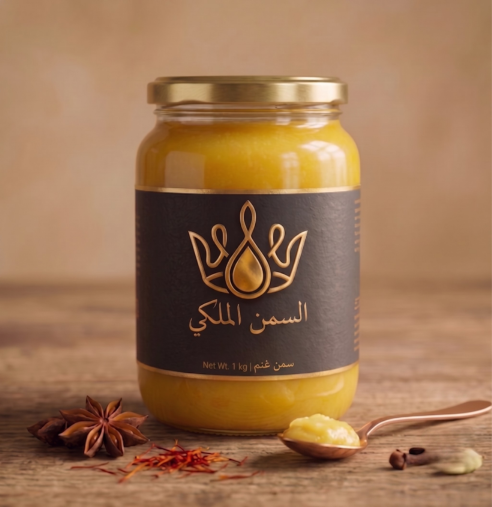
Pure Syrian clarified butterfat rendered and slowly cooled to deliver a luxurious granular texture that melts effortlessly
9. Frequently Asked Ghee Texture Questions
Why is ghee solid in winter and liquid in summer?
Milkfat fatty acids have natural melting points around 32°C. These seasonal state changes reflect 100% natural purity free from artificial hydrogenated stabilizers.
Do granular crystal grains indicate added sugar or salt?
No. Granular grains (Danedar) are pure crystallized milkfat triglycerides that dissolve instantly between your fingers with a silky, residue-free feel.
How can I prevent ghee from becoming a flat waxy block?
Avoid placing warm melted ghee directly into freezers or rapid-chill zones; cooling slowly in an ambient pantry allows natural spherical Beta-prime grains to develop.